
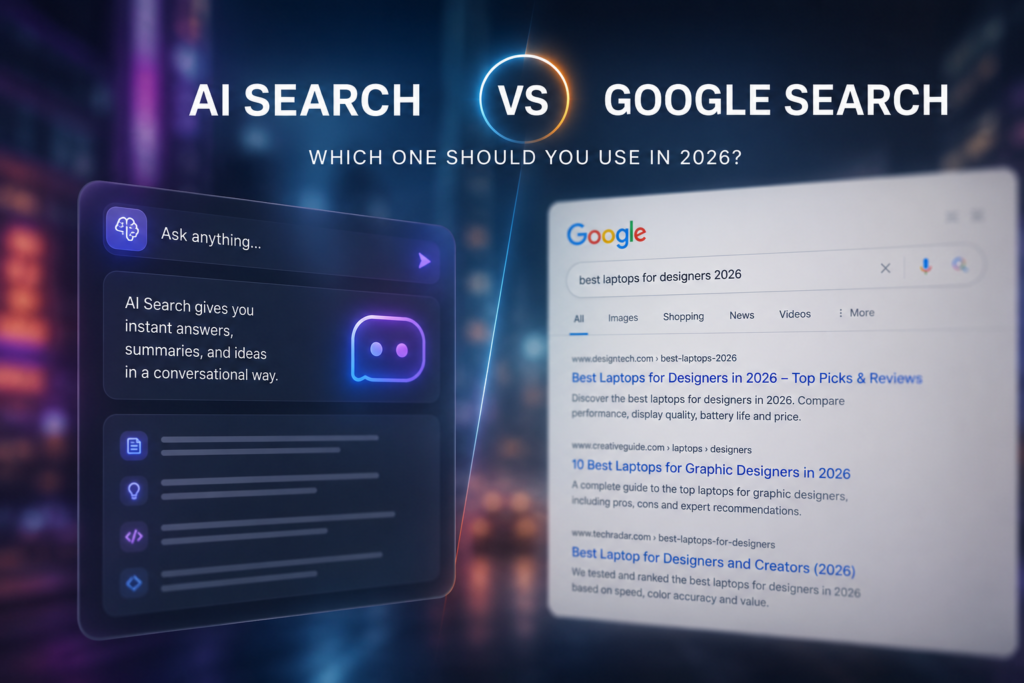

The way people search for information online is changing faster than ever. For more than two decades, Google Search has been the world’s primary gateway to the internet, helping billions of users find websites, answers, products, businesses, news, and educational resources in just a few seconds.
However, the rise of artificial intelligence has introduced a new way to explore the web. Instead of scrolling through dozens of search results, users can now ask questions in natural language and receive complete, conversational answers almost instantly. AI-powered search tools have transformed the traditional search experience by understanding context, summarizing information, and assisting with everything from research and writing to coding and business planning.
In 2026, many internet users are asking an important question: Should I use AI Search or Google Search?
The answer isn’t as straightforward as choosing one over the other. Both technologies are incredibly powerful, but they are designed for different purposes. While AI Search excels at generating detailed explanations, brainstorming ideas, and simplifying complex topics, Google Search continues to dominate when it comes to finding real-time information, official websites, local businesses, and the latest news.
Understanding the strengths and limitations of each search method can help you save time, improve productivity, and make better decisions when searching online.
In this comprehensive guide, we’ll compare AI Search and Google Search in detail, explain how each technology works, discuss their advantages and disadvantages, and help you determine which one is best for different situations. Whether you’re a student, business owner, marketer, developer, or simply someone who uses the internet every day, this guide will help you navigate the future of online search with confidence.
What Is AI Search?
AI Search is a modern approach to finding information online that uses artificial intelligence to understand questions, analyze context, and generate direct, conversational answers. Instead of presenting a long list of blue links like traditional search engines, AI Search aims to provide a complete response that feels more like speaking with an expert than browsing the web.
Rather than requiring users to search using short keywords, AI Search allows people to ask questions naturally. For example, instead of typing:
best laptops 2026
You can simply ask:
“I’m a graphic designer with a budget of $1,500. Which laptop should I buy and why?”
The AI understands the intent behind the question, evaluates relevant information, and produces a personalized response that explains the reasoning behind its recommendations.
This conversational experience has made AI Search increasingly popular for learning, research, writing, coding, planning, and problem-solving.
How Does AI Search Work?
Unlike traditional search engines that primarily match keywords with indexed web pages, AI Search relies on advanced machine learning models known as Large Language Models (LLMs).
These models are trained on vast amounts of text from books, articles, websites, documentation, and other publicly available sources. Instead of simply locating matching pages, they analyze the meaning behind a question and generate responses based on patterns they have learned.
When you ask an AI Search engine a question, several processes happen within seconds:
- It understands the intent of your question.
- It identifies the context behind your request.
- It analyzes relevant information.
- It generates a natural-language response.
- In many cases, it cites sources or links to supporting information.
This makes AI Search particularly effective for questions that require explanations rather than just links.
For example, if you ask:
“Explain blockchain technology like I’m 12 years old.”
A traditional search engine may return hundreds of articles.
An AI Search tool will usually provide a simple explanation immediately, saving valuable time.
Why Is AI Search Becoming So Popular?
The popularity of AI Search has grown rapidly because it solves many frustrations users experience with traditional search engines.
Instead of opening multiple websites, comparing information, and filtering through advertisements, AI Search combines relevant information into a single response.
Some of the biggest reasons behind its rapid adoption include:
Faster Learning
Students and professionals can understand complicated topics in minutes instead of spending hours reading multiple articles.
Better Productivity
AI Search assists with writing emails, creating reports, summarizing documents, generating ideas, solving programming problems, and organizing information more efficiently.
Natural Conversations
People no longer need to think about the “perfect keyword.”
Instead, they can simply ask questions as they would ask another person.
Personalized Responses
AI can adjust answers based on the user’s goals.
For example:
“Recommend a digital marketing strategy for a local construction company with a small budget.”
The response is tailored specifically to that situation instead of providing generic information.
Time Savings
Because AI summarizes information instantly, users spend less time clicking between websites and more time acting on the information they receive.
Popular AI Search Tools in 2026
The AI Search landscape has expanded significantly over the past few years, with several platforms offering unique strengths and features. Some focus on deep research, while others excel at productivity, coding assistance, or conversational answers.
Some of the most widely used AI Search tools include:
- ChatGPT Search
- Google Gemini
- Perplexity AI
- Claude AI
- Microsoft Copilot
Although each platform works differently, they all share a common goal: helping users find accurate information faster through natural conversations rather than traditional keyword-based searches.
As competition continues to grow, these tools are becoming smarter, more accurate, and better at understanding complex questions, making AI Search an increasingly valuable part of everyday internet use.
What Makes AI Search Different from Traditional Search?
The biggest difference lies in how information is presented.
Traditional search engines primarily help users discover websites. Their role is to index billions of pages, rank them based on relevance, and let users decide which result best answers their question.
AI Search takes a different approach.
Instead of acting only as a directory of web pages, it acts as an intelligent assistant. It reads, interprets, and synthesizes information before presenting a concise answer tailored to the user’s request.
For example, if you search:
“How can I improve my website’s SEO?”
A traditional search engine will typically display guides, blog posts, videos, and forums.
An AI Search engine is more likely to explain the core principles—such as keyword research, technical SEO, page speed, content quality, and backlinks—in a single, organized response. It may then suggest practical next steps or recommend additional resources if you want to explore the topic further.
This shift from finding information to understanding information is one of the biggest reasons AI Search is reshaping how people interact with the internet.
However, AI Search is not perfect. It can occasionally generate inaccurate or outdated information, especially on fast-changing topics. That’s why many users still rely on traditional search engines for breaking news, official announcements, and real-time updates.
What Is Google Search?
For more than 25 years, Google Search has been the world’s most widely used search engine, helping billions of people discover information across the internet. Whether you’re looking for the latest news, researching a product, finding a local business, or learning a new skill, Google remains the first choice for many internet users.
Unlike AI Search, which generates direct answers, Google Search is designed to help users discover the most relevant web pages for their query. It scans and indexes billions of websites, evaluates their quality and relevance, and displays the best results within seconds.
Google’s mission has always been simple: organize the world’s information and make it universally accessible and useful.
Today, Google Search is much more than a list of blue links. It includes AI-powered summaries, featured snippets, knowledge panels, images, videos, maps, shopping results, and interactive tools that help users find information faster than ever before.
How Does Google Search Work?
Google Search operates through three main stages:
1. Crawling
Google uses automated programs called Googlebots to discover new and updated pages across the internet. These bots continuously visit websites, follow links, and collect information about web pages.
Without crawling, Google wouldn’t know that a page exists.
2. Indexing
After discovering a page, Google analyzes its content and stores it in a massive database known as the Google Index.
During this process, Google attempts to understand:
- What the page is about
- The keywords it targets
- The quality of the content
- Images and videos
- Structured data
- Internal and external links
- Mobile usability
- Page speed
Only pages that meet Google’s quality requirements are added to the index.
3. Ranking
When someone performs a search, Google evaluates hundreds of ranking signals to determine which pages best answer the user’s question.
These signals include factors such as:
- Content relevance
- Helpful and original content
- Website authority
- User experience
- Core Web Vitals
- Backlinks
- Freshness of information
- Mobile optimization
- HTTPS security
Within milliseconds, Google displays what it believes are the most useful search results.
Google’s AI Evolution in 2026
Although many people think of Google as a traditional search engine, it has rapidly embraced artificial intelligence.
Today, Google integrates AI into nearly every aspect of search, making it easier for users to find accurate and relevant information.
Some AI-powered features include:
AI Overviews
Google can generate summarized answers directly within search results for many informational queries.
Featured Snippets
Quick answers displayed at the top of search results, often extracted from authoritative websites.
Knowledge Panels
Information boxes that provide facts about businesses, people, places, organizations, and topics.
Visual Search
Users can search using images instead of text through tools like Google Lens.
Voice Search
People can ask questions using their voice through smartphones and smart devices.
Personalized Results
Google tailors search results based on factors such as location, language, previous searches, and user preferences.
These innovations demonstrate that Google isn’t standing still—it is actively evolving to meet changing user expectations while maintaining access to the broader web.
AI Search vs Google Search: Key Differences
Although both tools help users find information, they serve different purposes and provide very different experiences.
Understanding these differences will help you choose the right tool for each situation.
Search Experience
The biggest difference is how information is presented.
Google Search provides a list of relevant websites, allowing users to compare multiple sources before deciding which one to trust.
AI Search, on the other hand, provides a complete answer immediately, reducing the need to visit multiple websites.
If your goal is to explore different perspectives or verify information yourself, Google Search is usually the better option.
If you simply want a quick explanation or solution, AI Search is often more convenient.
Speed
Both platforms are incredibly fast, but they save time in different ways.
Google delivers search results almost instantly, but users often need to open several websites before finding exactly what they need.
AI Search spends a few extra seconds generating a response, but it usually eliminates the need to browse multiple pages.
For research-heavy tasks, this can significantly improve productivity.
Accuracy
Google Search generally provides access to original sources, making it easier to verify facts.
AI Search can produce highly accurate explanations, but it may occasionally misunderstand context or generate incorrect information, especially when discussing recent events or specialized topics.
For important decisions involving legal, financial, or medical information, it’s always wise to verify AI-generated responses using trusted sources.
Real-Time Information
Google has a clear advantage when information changes quickly.
It continuously indexes new content across millions of websites, making it ideal for:
- Breaking news
- Sports scores
- Stock market updates
- Weather forecasts
- Flight information
- Government announcements
- Product availability
AI Search may not always have immediate access to the latest developments, depending on the platform and how it retrieves information.
Research
AI Search excels at simplifying complex subjects.
Instead of reading ten different articles, users receive a summarized explanation that highlights the most important concepts.
However, Google remains essential when deeper research requires reviewing multiple opinions, studies, or official documentation.
Many professionals actually use both together—starting with AI Search for a quick overview and then using Google Search to explore original sources.
Productivity
When it comes to productivity, AI Search has transformed how people work.
It can help users:
- Write emails
- Generate reports
- Summarize documents
- Create business plans
- Brainstorm ideas
- Debug code
- Translate content
- Draft marketing copy
Google Search supports these tasks by helping users locate tutorials, documentation, templates, and expert resources, but it generally doesn’t complete the work for you.
Learning
For educational purposes, AI Search often feels like having a personal tutor.
Users can ask follow-up questions, request simpler explanations, or explore related topics through natural conversation.
Google Search offers access to a wider range of educational materials, including university websites, research papers, videos, online courses, and forums.
The best learning experience often comes from combining both approaches.
Transparency
Google Search allows users to see exactly where information comes from by displaying links to websites.
AI Search sometimes summarizes information without making the original sources as obvious, depending on the platform.
For journalists, researchers, and academic users, transparent sourcing remains an important advantage of traditional search engines.
AI Search vs Google Search Comparison Table
| Feature | AI Search | Google Search |
|---|---|---|
| Primary Purpose | Generate direct answers | Discover relevant websites |
| User Experience | Conversational | Link-based |
| Speed | Fast answers with summaries | Instant search results |
| Research | Excellent for quick understanding | Excellent for in-depth research |
| Real-Time Updates | Limited on some platforms | Outstanding |
| Local Businesses | Basic | Excellent |
| Maps & Navigation | Limited | Excellent |
| Shopping | Basic recommendations | Comprehensive shopping ecosystem |
| News Coverage | Depends on AI platform | Excellent |
| Coding Assistance | Excellent | Good |
| Writing Help | Excellent | Limited |
| Source Verification | May vary | Strong |
| Learning | Interactive explanations | Access to diverse educational resources |
| Best For | Productivity, research, writing | News, navigation, shopping, official information |
Which One Is Better?
The answer depends entirely on what you’re trying to accomplish.
If you need a quick explanation, help writing content, brainstorming ideas, solving coding problems, or summarizing long documents, AI Search can save a tremendous amount of time.
If you’re looking for the latest news, official government websites, local businesses, product reviews, shopping comparisons, academic studies, or information that requires independent verification, Google Search remains the stronger choice.
Rather than viewing them as competitors, it’s more accurate to think of them as complementary tools.
Many professionals, students, marketers, developers, and business owners now use AI Search and Google Search together. They begin with AI to understand a topic quickly and then switch to Google to validate information, compare sources, and dive deeper into specific areas.
As search technology continues to evolve, the most effective internet users won’t choose one over the other—they’ll know when to use each tool to get the best possible results.