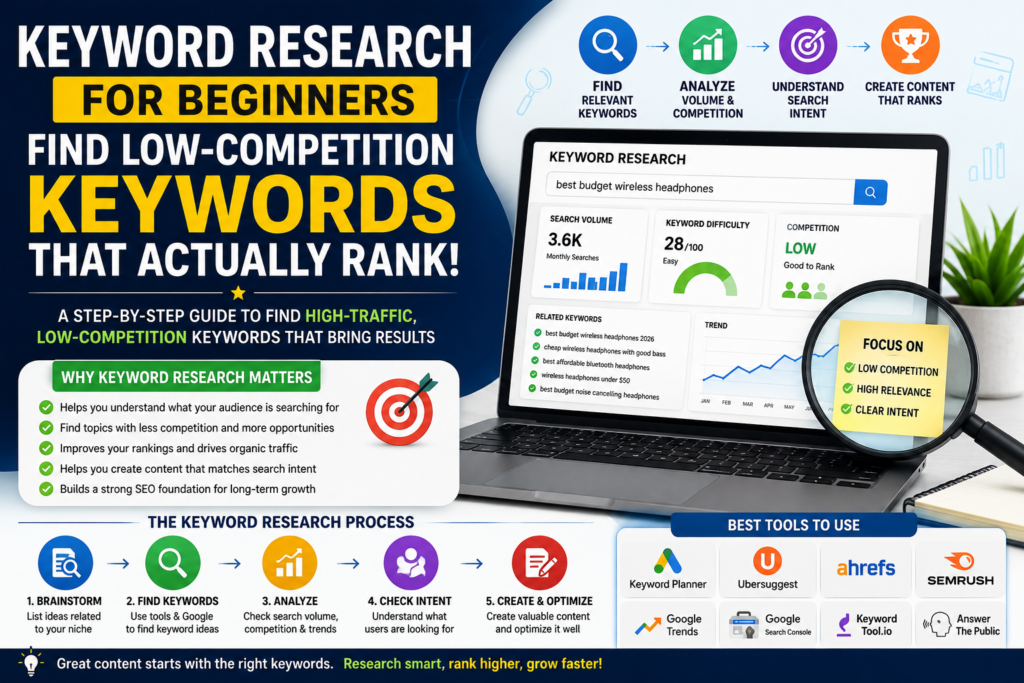

If you’ve ever published a blog post that received little or no traffic, you’re not alone. One of the biggest reasons new websites struggle to rank on Google is poor keyword research.
Many beginners make the mistake of writing about topics they think people are searching for instead of targeting keywords with proven search demand. The result? Great content that remains invisible because it’s optimized for the wrong audience or competes with highly established websites.
The good news is that effective keyword research isn’t as complicated as it may seem. With the right strategy, you can discover topics your target audience is actively searching for and identify keywords that offer a realistic opportunity to rank.
In this beginner-friendly guide, you’ll learn what keyword research is, why it’s important, how search intent works, and how to find low-competition keywords that can drive steady organic traffic to your website.
Table of Contents
- What Is Keyword Research?
- Why Keyword Research Matters
- Understanding Search Intent
- Types of Keywords
- What Are Long-Tail Keywords?
- How to Find Low-Competition Keywords
- Best Keyword Research Tools
- Common Keyword Research Mistakes
- Frequently Asked Questions
- Final Thoughts
What Is Keyword Research?
Keyword research is the process of discovering the words and phrases people type into search engines like Google when looking for information, products, or services.
For example, instead of writing a general article about “phones,” you might target a more specific keyword like:
- How to Speed Up a Slow Android Phone
- Best Android Apps in 2026
- Android Battery Draining Fast
These keywords reflect real search queries and make it easier to create content that matches what users are looking for.
Simply put, keyword research helps you write content people actually want to read.
Why Is Keyword Research Important?
Without keyword research, creating SEO content becomes a guessing game.
A good keyword strategy helps you:
- Understand what your audience is searching for.
- Create content that matches user intent.
- Increase organic traffic.
- Improve your chances of ranking on Google.
- Discover new content ideas.
- Build topical authority in your niche.
Instead of publishing random articles, you’ll create content based on real search demand.
Understanding Search Intent
One of the most important parts of keyword research is understanding search intent—the reason behind a user’s search.
Google aims to show results that best match what the user wants.
There are four main types of search intent:
1. Informational Intent
The user wants to learn something.
Examples:
- What is SEO?
- How does AI work?
- How to speed up an Android phone
These keywords are ideal for blog posts and guides.
2. Navigational Intent
The user wants to find a specific website or page.
Examples:
- Google Search Console
- WordPress login
- Canva dashboard
3. Commercial Investigation
The user is researching before making a decision.
Examples:
- Best laptops for students
- ChatGPT review
- Microsoft Office review
Review and comparison articles work well for these searches.
4. Transactional Intent
The user is ready to take action, such as making a purchase or signing up.
Examples:
- Buy wireless earbuds
- Best web hosting deals
- SEO tools pricing
These keywords are valuable for affiliate marketing and product pages.
Types of Keywords
Understanding different keyword types helps you build a balanced SEO strategy.
Short-Tail Keywords
These are broad search terms with high search volume and strong competition.
Examples:
- SEO
- Android
- Blogging
Ranking for these keywords can be difficult, especially for new websites.
Long-Tail Keywords
Long-tail keywords are more specific phrases, often containing three or more words.
Examples:
- Keyword research for beginners
- How to optimize images for SEO
- Best free AI tools for students
Although they usually have lower search volume, they often attract more targeted visitors and are easier to rank for.
Question-Based Keywords
Many users search using questions.
Examples:
- What is keyword research?
- How does Google rank websites?
- Why is my website not ranking?
These are excellent opportunities to appear in featured snippets.
What Makes a Good Keyword?
A strong keyword generally has these characteristics:
- Clear search intent
- Reasonable search volume
- Low to moderate competition
- Relevance to your website
- Potential for long-term traffic
The goal isn’t to chase the highest search volume—it’s to find keywords that your website has a realistic chance of ranking for.
How to Find Low-Competition Keywords
Finding low-competition keywords is one of the best ways for new websites to gain visibility.
Here are a few effective methods:
Use Google’s Autocomplete
Start typing a topic into Google’s search bar and note the suggested searches. These suggestions are based on real user queries and can reveal valuable long-tail keywords.
Check the “People Also Ask” Section
Google’s People Also Ask box is a great source of related questions that users commonly search for. These questions can inspire blog sections or even entire articles.
Explore Related Searches
Scroll to the bottom of Google search results to find related searches. These often reveal additional keyword opportunities closely connected to your main topic.
Analyze Competitor Content
Look at websites in your niche to see which topics they cover and identify content gaps you can fill with more detailed or up-to-date articles.
Think Like Your Audience
Ask yourself:
- What problems are they trying to solve?
- What questions do beginners ask?
- What would they type into Google?
Focusing on user needs often leads to valuable keyword ideas.
Best Keyword Research Tools
Several tools can help you discover keywords and evaluate their potential.
Popular options include:
- Google Keyword Planner
- Google Search Console
- Google Trends
- Ahrefs
- SEMrush
- Ubersuggest
- Moz Keyword Explorer
- KeywordTool.io
Even if you’re just starting out, combining free tools with Google Search itself can provide plenty of ideas.
Keyword Research for Beginners: How to Find Low-Competition Keywords That Actually Rank (2026 Guide) – Part 2
Continue reading from Part 1
How to Evaluate Keyword Difficulty
Finding a keyword is only the first step. Before creating content, you should determine how difficult it will be to rank for that keyword.
Keyword difficulty measures how competitive a search term is based on the strength of the websites already ranking on the first page of Google.
Signs a Keyword May Be Difficult
- The first page is dominated by well-known websites.
- Many results have thousands of backlinks.
- Articles are extremely detailed and regularly updated.
- Major brands occupy most of the top positions.
For a new website, it’s usually better to target less competitive keywords and build authority over time.
Search Volume vs. Competition
Many beginners choose keywords solely because they have high search volume. However, search volume is only one part of the equation.
A keyword with 100 monthly searches and low competition may bring more traffic than a keyword with 10,000 searches that is nearly impossible to rank for.
A balanced keyword typically has:
- Clear search intent
- Moderate search volume
- Low to medium competition
- Relevance to your niche
For newer websites, targeting long-tail keywords often delivers better results than competing for broad, highly competitive terms.
Build Topic Clusters Instead of Isolated Articles
Google increasingly rewards websites that demonstrate expertise across an entire topic.
Instead of publishing unrelated articles, organize your content into topic clusters.
Example: Android Content Cluster
- Android 16: Complete Guide to New Features
- How to Speed Up a Slow Android Phone
- Android Battery Draining Fast? 15 Ways to Fix It
- Best Android Apps You Should Install in 2026
- Hidden Android Features You Probably Didn’t Know About
Each article supports the others through internal links, helping search engines understand your site’s topical authority.
How to Use Keywords Naturally
Once you’ve selected a keyword, place it strategically throughout your article without overusing it.
Best Places to Include Your Focus Keyword
- SEO title
- URL slug
- Main heading (H1)
- First paragraph
- At least one H2 heading
- Meta description
- Image alt text
- Conclusion (where it fits naturally)
Avoid forcing the keyword into every sentence. Write for readers first, and let keywords fit naturally into the content.
Use Related Keywords
Google understands context, so you don’t need to repeat the exact same phrase throughout your article.
Instead, include related terms and synonyms.
For an article about keyword research, related phrases might include:
- SEO keywords
- Search intent
- Long-tail keywords
- Organic traffic
- Google rankings
- Content optimization
- Keyword difficulty
Using natural language helps improve readability and supports semantic SEO.
Track Your Keyword Performance
Publishing an article is only the beginning. Monitoring performance helps you understand what’s working and where improvements are needed.
Keep an eye on:
- Organic traffic
- Click-through rate (CTR)
- Average ranking position
- Impressions
- User engagement
- Bounce rate
- Time spent on the page
Reviewing this data regularly allows you to update and improve existing content over time.
Common Keyword Research Mistakes
Avoid these common mistakes if you want your content to perform well.
Chasing High-Volume Keywords Only
High search volume often comes with intense competition. New websites usually have a better chance of ranking for specific long-tail keywords.
Ignoring Search Intent
Even if you rank for a keyword, users may leave quickly if your content doesn’t match what they were expecting.
Always create content that satisfies the intent behind the search.
Keyword Stuffing
Repeating the same keyword excessively can make your content difficult to read and may negatively affect SEO.
Write naturally and focus on providing value.
Skipping Internal Links
Linking related articles helps visitors discover more content and helps search engines understand your site’s structure.
Not Updating Old Articles
SEO isn’t a one-time task. Refreshing older posts with updated information, new examples, and improved optimization can help maintain or improve rankings.
Simple Keyword Research Workflow
Here’s a straightforward process you can follow for every new blog post:
- Choose a broad topic.
- Find related long-tail keywords.
- Understand the search intent.
- Check the competition.
- Select one primary keyword.
- Identify several related keywords.
- Create helpful, in-depth content.
- Optimize the title, headings, and meta description.
- Add internal links to relevant articles.
- Monitor performance and update the content regularly.
Following this workflow consistently can help you build sustainable organic traffic over time.
Frequently Asked Questions
What is keyword research?
Keyword research is the process of finding the search terms people use on Google so you can create content that matches their interests and search intent.
Are long-tail keywords better for beginners?
Yes. Long-tail keywords usually have lower competition and attract more targeted visitors, making them a good choice for newer websites.
How many keywords should one blog post target?
It’s generally best to focus on one primary keyword and naturally include several closely related secondary keywords throughout the article.
Is keyword stuffing good for SEO?
No. Overusing keywords can hurt readability and may negatively impact your search performance. Focus on creating helpful, natural content instead.
How often should I do keyword research?
Keyword research should be an ongoing process. Trends change, new topics emerge, and search behavior evolves, so it’s helpful to review your keyword strategy regularly.
Can I rank without keyword research?
It’s possible, but much less likely. Keyword research helps you create content that aligns with what people are actually searching for, increasing your chances of ranking.
Final Thoughts
Keyword research is the foundation of every successful SEO strategy. By understanding what your audience is searching for and creating content that directly addresses their needs, you improve your chances of ranking on search engines and attracting consistent organic traffic.
Remember that effective keyword research isn’t about finding the biggest keywords—it’s about finding the right keywords. Long-tail phrases, clear search intent, and well-structured content often outperform broad topics, especially for newer websites.
As your website grows, continue refining your keyword strategy, updating existing articles, and building topic clusters around your core subjects. Over time, this approach can establish your site as a trusted resource and support long-term SEO success.