
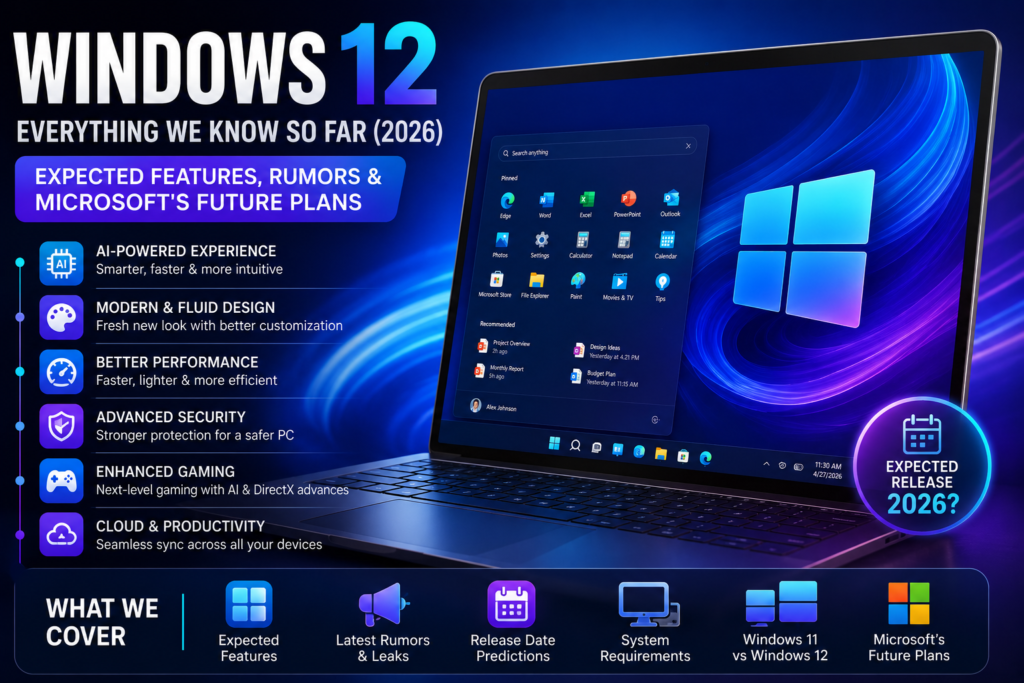

For months, technology enthusiasts have been asking the same question: Will Microsoft release Windows 12? While the company has introduced major updates to Windows 11 and invested heavily in artificial intelligence, many people are curious about what the next generation of Windows might look like.
Although Microsoft has not officially unveiled a product called Windows 12, there has been plenty of discussion about the future of the Windows platform. Industry analysts, hardware manufacturers, and technology observers have pointed to trends that suggest Microsoft’s next major operating system could place an even stronger focus on AI, productivity, security, and cloud-powered experiences.
It’s important to separate confirmed information from speculation. Many websites present rumors as facts, which can be confusing for readers. In this guide, we’ll clearly explain what Microsoft has officially shared about the future of Windows, what industry experts expect, and which rumored features are most likely to appear if a future version of Windows is released.
Whether you’re planning to upgrade your PC, buy a new laptop, or simply stay informed about Microsoft’s roadmap, this article will give you a balanced overview of what we know so far.
Table of Contents
- Is Windows 12 Official?
- What Microsoft Has Confirmed
- Why People Expect Windows 12
- Expected AI Features
- User Interface Improvements
- Performance Enhancements
- Gaming Improvements
- Security Features
- Possible Release Timeline
- Expected System Requirements
- Windows 11 vs Future Windows
- Frequently Asked Questions
- Final Thoughts
Is Windows 12 Official?
This is the most important question—and the answer is simple.
As of 2026, Microsoft has not officially announced a consumer operating system named “Windows 12.”
That means there is currently:
- No confirmed release date
- No official feature list
- No official pricing
- No supported device list
- No public installation files
However, Microsoft continues to update Windows 11 with major feature releases while investing heavily in artificial intelligence, cloud computing, and next-generation PC experiences.
Because of these ongoing developments, many people refer to Microsoft’s future desktop operating system as Windows 12, even though the company has not formally introduced that name.
Why Do People Believe Windows 12 Is Coming?
There are several reasons why discussions about Windows 12 continue to grow.
Regular Windows Evolution
Microsoft has historically introduced major Windows versions that bring new technologies, refreshed interfaces, and improved hardware support.
Each generation has focused on modern computing needs, and many users naturally expect another significant update in the future.
AI-Powered PCs
One of Microsoft’s biggest priorities today is integrating artificial intelligence directly into Windows.
Modern computers increasingly include dedicated AI hardware capable of accelerating intelligent features such as:
- Live translation
- Image enhancement
- Voice recognition
- Smart search
- Content generation
- Productivity assistants
Many experts believe Microsoft’s future operating system will be designed to take full advantage of these AI-powered PCs.
New Hardware
Computer manufacturers continue releasing laptops and desktops equipped with faster processors, improved graphics, and dedicated neural processing units (NPUs).
These advances provide the foundation for more advanced operating system features that rely on local AI processing instead of cloud-only services.
What Microsoft Has Officially Focused On
Although the company hasn’t officially introduced Windows 12, Microsoft has made several priorities clear through recent Windows updates and announcements.
These include:
- Artificial Intelligence integration
- Better security
- Faster performance
- Improved accessibility
- Cloud connectivity
- Productivity improvements
- Enhanced gaming experiences
- Better battery efficiency
These areas are likely to influence whatever comes next for Windows.
Expected AI Features
Artificial Intelligence is expected to play a much larger role in future Windows experiences.
While specific features have not been confirmed for a product called Windows 12, many observers expect Microsoft to continue expanding AI across the operating system.
Possible improvements may include:
Smarter Search
Future Windows versions could provide faster and more context-aware search results across files, settings, and applications.
Instead of remembering exact file names, users may simply describe what they’re looking for.
AI Writing Assistance
Built-in writing tools may help users:
- Draft emails
- Summarize documents
- Rewrite text
- Improve grammar
- Generate ideas
These capabilities could save time for students, professionals, and content creators.
Intelligent File Organization
Artificial intelligence may automatically organize files, suggest folders, identify duplicate documents, and make searching easier.
Better Voice Commands
Voice assistants could become more conversational and capable of handling complex requests without requiring precise commands.
AI-Powered Accessibility
Future accessibility features may include:
- Real-time captions
- Automatic translations
- Voice narration
- Improved speech recognition
- Better support for users with disabilities
These improvements would make Windows more inclusive for a wider range of users.
A More Modern User Interface
Every major Windows release typically introduces visual improvements.
Although Microsoft has not confirmed a redesigned interface for Windows 12, several enhancements are widely expected.
Potential improvements include:
- Cleaner Start menu
- More customizable taskbar
- Better touch support
- Dynamic widgets
- Adaptive layouts
- Improved dark mode
- Enhanced animations
- Consistent design language across applications
The goal would likely be to create a simpler, faster, and more intuitive user experience.
Performance Improvements
Performance is another area where users expect meaningful improvements.
Possible enhancements could include:
- Faster startup times
- Reduced memory usage
- Better battery optimization
- Improved multitasking
- Faster application launches
- More efficient background processes
These improvements could benefit both older hardware and newer AI-capable devices.
Better Gaming Experience
Gaming continues to be one of Windows’ biggest strengths.
Future Windows updates may expand support for:
- Faster game loading
- Improved graphics technologies
- Better Game Mode optimization
- Enhanced controller compatibility
- Lower system latency
- Better cloud gaming integration
Gamers are likely to benefit from continued optimization as hardware evolves.
Windows 12: Everything We Know So Far (2026) – Expected Features, Rumors & Microsoft’s Future Plans (Part 2)
Continue reading from Part 1
Expected Security Improvements
Security has become one of Microsoft’s biggest priorities in recent years. Every major Windows update has introduced stronger protection against cyber threats, and it’s reasonable to expect future versions of Windows to continue this trend.
Although Microsoft has not confirmed specific security features for a future operating system called Windows 12, experts expect improvements in several areas.
Possible enhancements include:
- Better phishing protection
- Stronger ransomware defense
- Enhanced biometric authentication
- Improved Windows Defender capabilities
- More intelligent threat detection
- Better application isolation
- Stronger cloud security integration
These improvements would help protect users against increasingly sophisticated cyberattacks while requiring less manual configuration.
Smarter Integration with AI PCs
One of the biggest changes in modern computing is the rise of AI PCs—computers equipped with dedicated Neural Processing Units (NPUs) designed to accelerate artificial intelligence tasks.
Future Windows versions are expected to take greater advantage of this hardware.
Possible AI-powered capabilities include:
- Faster image editing
- Live language translation
- AI-powered meeting enhancements
- Background noise removal
- Intelligent battery optimization
- Smart power management
- Local AI processing for improved privacy
- Faster voice recognition
By processing many AI tasks directly on the device, users could experience better performance while reducing dependence on cloud services.
Expected System Requirements
Since Microsoft has not announced Windows 12, there are no official hardware requirements.
However, based on current Windows trends, future versions may continue to prioritize modern hardware.
Possible requirements could include:
- 64-bit processor
- TPM 2.0 support
- Secure Boot
- UEFI firmware
- Sufficient RAM for AI features
- SSD storage for improved performance
- Dedicated NPU for advanced AI capabilities (on supported devices)
These expectations are based on current hardware trends rather than official Microsoft specifications.
Possible Release Timeline
One of the most common questions is:
When will Windows 12 be released?
At the time of writing, Microsoft has not announced an official release date.
Technology analysts have suggested that a future major Windows release could arrive after continued development of Windows 11 and Microsoft’s broader AI initiatives, but no confirmed schedule has been published.
For now, users should rely only on official Microsoft announcements rather than rumors circulating online.
Windows 11 vs. a Future Windows Release
Although there is no official Windows 12 to compare yet, it’s possible to look at the direction Microsoft appears to be heading.
| Feature | Windows 11 | Future Windows (Expected) |
|---|---|---|
| AI Features | Growing support | More deeply integrated AI experiences |
| Performance | Optimized | Expected to improve further |
| Security | Strong | Likely to become even more advanced |
| User Interface | Modern design | Potentially more customizable |
| Gaming | Excellent | Continued optimization expected |
| Cloud Integration | Strong | Deeper integration anticipated |
These comparisons are based on Microsoft’s current development priorities rather than confirmed product details.
Should You Wait for Windows 12?
For most users, the answer is no.
Windows 11 continues to receive regular feature updates, security improvements, and support from Microsoft. If your computer already runs Windows 11 well, there is little reason to delay buying a PC or upgrading solely because of Windows 12 rumors.
If Microsoft eventually announces a new Windows version, it will likely provide upgrade guidance for eligible devices.
Until then, using the latest supported version of Windows is generally the best option.
Who Might Benefit Most from Future Windows Versions?
If Microsoft introduces a next-generation Windows release, these users are likely to benefit the most:
Students
AI-powered study tools, smarter search, and productivity features could simplify research and note-taking.
Professionals
Business users may benefit from improved multitasking, enhanced security, and AI-assisted workflows.
Content Creators
Photo editing, video production, graphic design, and writing tools may become faster through deeper AI integration.
Gamers
Future Windows improvements could deliver better gaming performance, improved graphics technologies, and lower latency on supported hardware.
Businesses
Organizations may gain from stronger security controls, centralized device management, and AI-powered productivity features.
Frequently Asked Questions
Has Microsoft officially announced Windows 12?
No. At the time of writing, Microsoft has not officially announced a consumer operating system named Windows 12.
Is there a confirmed Windows 12 release date?
No. There is currently no official release date.
Will Windows 12 include more AI features?
Microsoft has made AI a major focus across Windows and its other products. While future AI enhancements are expected, specific Windows 12 features have not been confirmed.
Will Windows 11 users receive a free upgrade?
Microsoft has not announced any upgrade policy for a product called Windows 12. Users should wait for official guidance if a new Windows version is introduced.
Should I buy a Windows 11 PC now?
For most people, yes. Windows 11 is actively supported and continues to receive new features, performance improvements, and security updates.
Can older computers run future Windows versions?
This will depend on Microsoft’s official hardware requirements if and when a new version is released. Older systems may not support all future features, especially those requiring AI hardware.
Final Thoughts
Windows users are understandably excited about the possibility of a next-generation operating system. Advances in artificial intelligence, modern hardware, and cloud computing suggest that the future of Windows will continue to evolve in meaningful ways.
However, it’s important to separate expectations from confirmed information. While many rumors point toward a future version commonly referred to as Windows 12, Microsoft has not officially announced such a product or released detailed specifications.
For now, Windows 11 remains Microsoft’s primary desktop operating system and continues to receive regular improvements. If a future Windows release is announced, users can expect official information regarding features, compatibility, and upgrade options directly from Microsoft.
Until then, staying informed through trusted sources—and avoiding speculation presented as fact—is the best approach.