
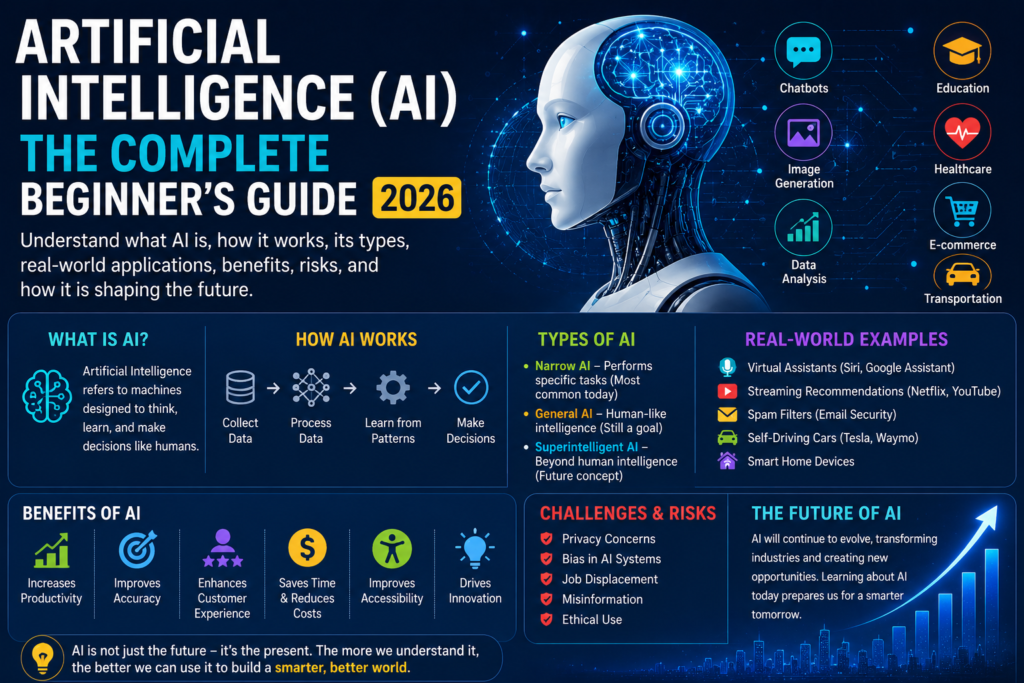

Artificial Intelligence, commonly known as AI, is no longer just a futuristic concept found in science fiction movies. Today, AI is part of our everyday lives. Whether you’re asking a virtual assistant a question, receiving personalized recommendations on a streaming platform, translating text instantly, or using smart features on your smartphone, chances are you’re interacting with AI.
Over the last few years, Artificial Intelligence has evolved rapidly, becoming one of the most influential technologies in the world. Businesses use it to automate repetitive tasks, healthcare providers rely on it to assist with medical research and diagnostics, educators use it to create personalized learning experiences, and content creators use AI-powered tools to improve productivity.
Despite its growing popularity, many people still wonder what AI actually is, how it works, and whether it will replace human jobs. The good news is that you don’t need a technical background to understand the basics.
This beginner-friendly guide explains Artificial Intelligence in simple language. We’ll explore how AI works, its different types, where it’s used, its advantages and challenges, and how it is likely to shape the future of technology.
Table of Contents
- What Is Artificial Intelligence?
- How AI Works
- Types of Artificial Intelligence
- Machine Learning vs Artificial Intelligence
- What Is Generative AI?
- Real-World Applications of AI
- Benefits of Artificial Intelligence
- Challenges and Risks
- AI Myths
- The Future of AI
- Frequently Asked Questions
- Final Thoughts
What Is Artificial Intelligence?
Artificial Intelligence is a branch of computer science focused on creating systems that can perform tasks normally associated with human intelligence.
These tasks include:
- Learning from data
- Recognizing speech
- Understanding language
- Solving problems
- Identifying images
- Making recommendations
- Detecting patterns
- Assisting with decision-making
Unlike traditional software that follows fixed instructions, many AI systems can improve their performance by learning from large amounts of data.
This ability to learn and adapt is one of the reasons AI has become such an important technology across many industries.
How Does Artificial Intelligence Work?
At its core, AI works by processing data, identifying patterns, and making predictions or decisions based on what it has learned.
A simplified AI workflow looks like this:
- Collect data.
- Analyze patterns in the data.
- Learn from examples using algorithms.
- Make predictions or generate outputs.
- Improve over time as more data becomes available.
For example, an email service may learn to recognize spam messages by analyzing millions of emails and identifying common characteristics of unwanted content.
Similarly, a navigation app can analyze live traffic data to recommend faster routes.
Different Types of Artificial Intelligence
Artificial Intelligence can be categorized in several ways, but the following three types are commonly used to explain AI capabilities.
1. Narrow AI
Narrow AI, also known as Weak AI, is designed to perform specific tasks.
Examples include:
- Voice assistants
- Recommendation systems
- Language translation
- Spam filters
- Face recognition
- Navigation apps
Most AI applications people use today fall into this category.
2. General AI
General AI refers to a theoretical form of AI capable of understanding and performing a wide range of intellectual tasks at a human-like level.
Researchers continue to explore this concept, but systems with this level of general intelligence have not been achieved.
3. Superintelligent AI
Superintelligent AI describes a hypothetical future scenario in which AI exceeds human intelligence across nearly every domain.
This remains a topic of research and debate rather than current technology.
Machine Learning vs Artificial Intelligence
Many people use the terms Artificial Intelligence and Machine Learning interchangeably, but they are not exactly the same.
Artificial Intelligence
Artificial Intelligence is the broader field focused on creating systems capable of performing intelligent tasks.
Machine Learning
Machine Learning is a subset of AI that enables computers to learn from data without being explicitly programmed for every possible situation.
In simple terms:
- AI is the overall concept.
- Machine Learning is one of the methods used to build AI systems.
What Is Generative AI?
Generative AI is a type of AI designed to create new content rather than simply analyze existing information.
Depending on the system, it can generate:
- Text
- Images
- Music
- Videos
- Computer code
- Audio
- Designs
Generative AI has become increasingly popular because it helps people brainstorm ideas, write drafts, summarize information, and support creative projects.
While these tools can save time, users should always review AI-generated content for accuracy and suitability before publishing or relying on it.
Everyday Examples of AI
Many people interact with Artificial Intelligence without realizing it.
Examples include:
Smartphones
AI powers features such as:
- Voice assistants
- Camera enhancements
- Face recognition
- Predictive text
- Battery optimization
Streaming Services
Recommendation systems suggest movies, TV shows, and music based on your viewing or listening habits.
Online Shopping
E-commerce platforms use AI to recommend products, personalize search results, and detect fraudulent transactions.
Navigation Apps
AI helps estimate travel times, identify traffic congestion, and recommend alternative routes.
Search Engines
Search engines use AI to better understand search queries and deliver more relevant results.
Benefits of Artificial Intelligence
Artificial Intelligence offers many advantages for individuals, businesses, and organizations.
Increased Productivity
AI can automate repetitive tasks, allowing people to focus on more creative or strategic work.
Faster Decision-Making
By analyzing large amounts of data quickly, AI can support informed decision-making in areas such as finance, healthcare, and logistics.
Improved Personalization
AI helps deliver personalized recommendations for shopping, entertainment, learning, and more.
Better Accessibility
AI-powered speech recognition, translation, and assistive technologies make digital services more accessible to a wider range of users.
Continuous Availability
Unlike humans, AI-powered systems can often operate around the clock, assisting users whenever they need help.
Common Misconceptions About AI
As AI becomes more common, several myths continue to circulate.
Myth: AI Knows Everything
AI systems are limited by their design, training data, and the information available to them. They can make mistakes and should not be treated as infallible sources.
Myth: AI Will Immediately Replace All Jobs
AI is changing the way many people work, but in most industries it is being used to assist with tasks rather than replace entire professions. New roles and skills are also emerging alongside AI adoption.
Myth: AI Is Always Objective
AI systems can reflect biases present in their training data or design. Responsible development and human oversight remain important.
Artificial Intelligence (AI): The Complete Beginner’s Guide (2026) – Part 2
Continue reading from Part 1
How Artificial Intelligence Is Used Today
Artificial Intelligence is transforming nearly every industry. From healthcare to entertainment, AI is helping people work more efficiently, make informed decisions, and automate repetitive tasks.
Let’s explore some of the most common real-world applications of AI.
AI in Healthcare
Healthcare has become one of the fastest-growing areas for AI adoption.
Medical professionals use AI to assist with:
- Analyzing medical images
- Supporting disease detection
- Organizing patient records
- Drug discovery and research
- Predicting patient risks
- Improving hospital operations
AI supports healthcare professionals by processing large amounts of information quickly, but important medical decisions still rely on qualified human experts.
AI in Education
Education is becoming more personalized thanks to AI-powered learning platforms.
AI can help students by:
- Providing personalized study recommendations
- Creating practice quizzes
- Explaining complex topics
- Translating educational content
- Assisting with language learning
- Offering instant feedback
Teachers also use AI tools to save time on lesson planning, grading, and administrative tasks.
AI in Business
Businesses of all sizes are using AI to improve productivity and customer experiences.
Common business applications include:
- Customer support chatbots
- Sales forecasting
- Data analysis
- Marketing automation
- Inventory management
- Fraud detection
- Workflow automation
By automating repetitive work, employees can focus on higher-value tasks that require creativity and decision-making.
AI in Finance
Banks and financial institutions use AI to improve security and efficiency.
Examples include:
- Detecting fraudulent transactions
- Credit risk assessment
- Investment analysis
- Customer service automation
- Personalized financial recommendations
AI helps financial organizations process large amounts of data faster than traditional manual methods.
AI in Transportation
Modern transportation systems increasingly rely on AI.
Examples include:
- Navigation apps
- Traffic prediction
- Route optimization
- Driver assistance systems
- Fleet management
- Logistics planning
These technologies can help reduce travel times, improve fuel efficiency, and enhance road safety.
AI in Content Creation
Artificial Intelligence has become a valuable tool for writers, designers, marketers, and video creators.
AI can assist with:
- Brainstorming ideas
- Drafting articles
- Summarizing documents
- Editing grammar
- Creating images
- Generating code
- Producing marketing copy
It’s important to remember that AI works best as a creative assistant. Human review, editing, and fact-checking remain essential for producing high-quality content.
Benefits of Artificial Intelligence
AI offers many advantages when used responsibly.
Improved Productivity
AI can automate repetitive tasks, allowing individuals and businesses to complete work more efficiently.
Better Decision-Making
By analyzing large datasets quickly, AI can identify patterns and provide insights that support informed decisions.
Enhanced Customer Experience
Businesses use AI to deliver faster customer support, personalized recommendations, and more relevant services.
Increased Accessibility
Speech recognition, real-time translation, and assistive technologies help make digital tools more accessible to people with different needs.
Continuous Innovation
AI continues to drive innovation across healthcare, education, manufacturing, entertainment, and scientific research.
Challenges and Risks of AI
Despite its benefits, Artificial Intelligence also presents challenges that should not be ignored.
Privacy Concerns
AI systems often rely on large amounts of data. Protecting personal information and respecting user privacy are important considerations.
Bias
AI systems may reflect biases present in their training data, leading to unfair or inaccurate outcomes if not carefully designed and monitored.
Misinformation
Generative AI can create convincing text, images, and videos. While this technology has many positive uses, it also increases the importance of verifying information from reliable sources.
Job Changes
AI is changing the nature of work by automating certain tasks. At the same time, it is creating demand for new skills and new types of jobs.
Learning to work alongside AI will likely become an increasingly valuable skill.
How to Start Learning AI
You don’t need to be a programmer to begin understanding Artificial Intelligence.
Here are some practical ways to get started:
Learn the Basics
Understand key concepts such as:
- Artificial Intelligence
- Machine Learning
- Deep Learning
- Neural Networks
- Generative AI
Experiment with AI Tools
Trying AI tools yourself is one of the best ways to understand their capabilities and limitations.
Use them to:
- Generate ideas
- Summarize documents
- Improve writing
- Create images
- Organize information
- Learn new skills
Always review AI-generated content carefully before using it for important work.
Stay Informed
AI evolves rapidly. Following trusted technology news and official product announcements can help you stay updated on new developments.
Popular AI Tools for Beginners
Many beginner-friendly AI tools are available today for writing, research, design, coding, and productivity.
Some well-known examples include:
- AI chat assistants
- AI writing assistants
- AI image generators
- AI coding assistants
- AI transcription tools
- AI presentation creators
- AI productivity tools
Choose tools that match your goals, and remember that each has different strengths and limitations.
The Future of Artificial Intelligence
Artificial Intelligence is expected to continue influencing many aspects of daily life.
Future developments may include:
- Smarter virtual assistants
- More personalized education
- Improved healthcare support
- Better language translation
- Enhanced accessibility tools
- Advanced robotics
- More efficient business automation
While no one can predict exactly how AI will evolve, it’s clear that understanding this technology will become increasingly valuable in both personal and professional settings.
Frequently Asked Questions
What is Artificial Intelligence?
Artificial Intelligence is a field of computer science focused on creating systems that can perform tasks typically associated with human intelligence, such as learning, reasoning, recognizing patterns, and understanding language.
Is AI the same as Machine Learning?
No. Machine Learning is a subset of Artificial Intelligence that enables systems to learn from data and improve their performance without being explicitly programmed for every scenario.
Can AI replace humans?
AI can automate many repetitive tasks, but human creativity, critical thinking, empathy, and judgment remain essential in many professions.
Is Artificial Intelligence safe?
AI can provide many benefits when developed and used responsibly. However, issues such as privacy, bias, and misinformation require ongoing attention from developers, organizations, and policymakers.
Do I need coding skills to use AI?
No. Many AI-powered tools are designed for everyday users and require little or no programming knowledge.
What industries use AI?
AI is used across many industries, including healthcare, education, finance, retail, manufacturing, transportation, entertainment, marketing, and customer service.
Final Thoughts
Artificial Intelligence is no longer a technology of the future—it’s already a part of everyday life. From helping us search the web and navigate traffic to supporting businesses, healthcare providers, and educators, AI is changing how we live and work.
For beginners, the most important step is to understand what AI can and cannot do. While AI can automate tasks, generate ideas, and analyze large amounts of data, it still requires human oversight, critical thinking, and responsible use.
As AI continues to evolve, learning how to use these tools effectively will become an increasingly valuable skill. Whether you’re a student, professional, business owner, or simply curious about technology, building a basic understanding of AI today can help you prepare for tomorrow’s digital world.